From forecasting ocean conditions to understanding how crops respond to drought, two European satellites with key UK contributions have launched together and will expand our view of the Earth in unprecedented ways.
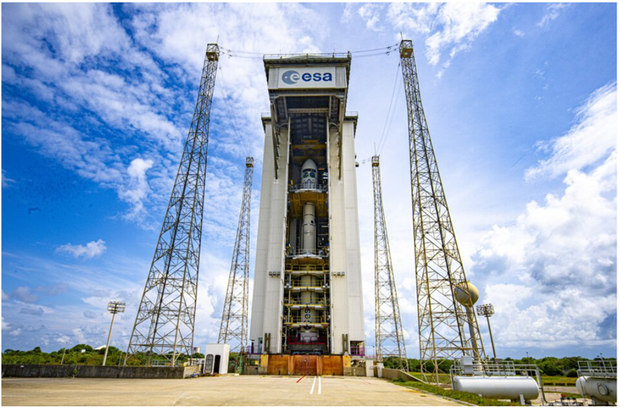
At 2:21 am UK time on 15 September, Sentinel 3C and FLEX launched aboard a Vega-C rocket from the European Spaceport in French Guiana. Sentinel-3C is the latest satellite in the Europe’s Copernicus programme, whilst FLEX is the European Space Agency’s eight Earth Explorer science mission.
Copernicus is the world’s leading Earth observation system, with six families of Sentinel missions that monitor the Earth providing vast amounts of free and openly accessible data that can be used for wide-ranging applications across climate resilience, food and water security, pollution monitoring and civil security.
Sentinel-3C is a mission that observes sea and land surface temperature, ocean and land colour and sea surface topography, which together build a picture of how the Earth’s systems are changing. The Sentinel-3 family of satellites enables various applications including ocean and weather forecasting, wildfire detection and water quality monitoring. For example, Sentinel-3 monitors changes in the colour of the ocean surface to detect and track algal blooms, which can contaminate seafood and degrade coastal air and water quality.
Through ocean forecasting, scientists can monitor their evolution and strengthen their understanding of how the ocean changes in response to the effects of climate change. This allows authorities to assess the potential impacts on marine ecosystems and empowers societies with tools to support the sustainable management of coastal waters and improve water quality.
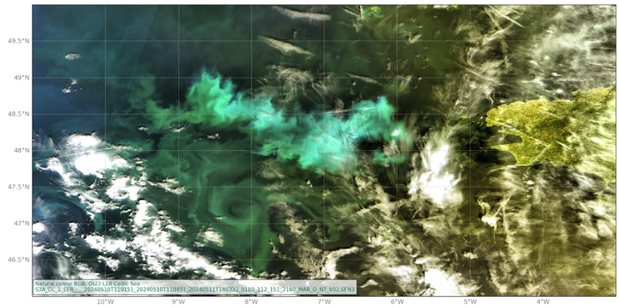
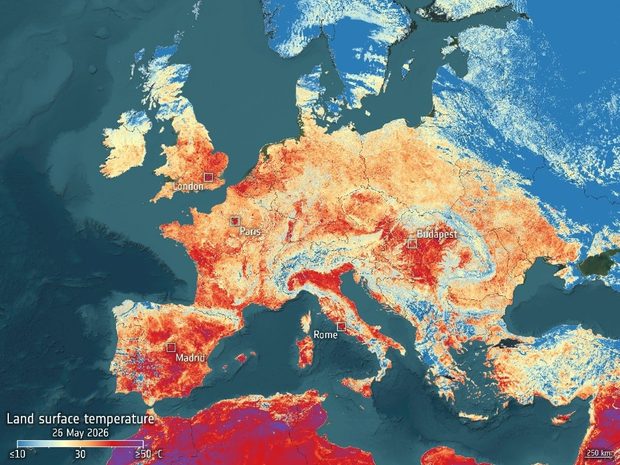
Sentinel-3 data is also used to respond to ongoing environmental challenges felt here at home. During the European heatwaves this year, Sentinel-3 observations provided valuable insights into land surface temperature, helping authorities assess the impact of heatwaves on communities.
Sentinel-3C also has wider synergies as an integrated element of the European Earth observation system. ESA’s FLEX (FLuorescence EXplorer) mission, which launched on the same rocket and will orbit in tandem with Sentinel-3C, is designed to help scientists understand vegetation health by detecting the faint light plants emit as they photosynthesise. This signal offers a direct window into how efficiently plants are converting sunlight into energy, and how they respond to stress from heat, drought, disease or other environmental pressures.
Together with Sentinel-3C, they form a unique tandem mission where FLEX directly measures plant photosynthesis and Sentinel-3 provides atmospheric, thermal and land-surface context to interpret these signals. Jointly, Sentinel-3C and FLEX deliver an unprecedented capability to provide a more complete view of global vegetation function and status.
The UK is contributing significantly to the success of both missions. On FLEX, TAS UK completed assembly, integration and testing activities on the satellite platform in Belfast, with Teledyne e2v supplying detector hardware for the FLORIS instrument, ABSL supplying spacecraft batteries, and Nammo Westcott providing propulsion hardware.
Director of the UK Space Agency, Rebecca Evernden said:
"The launch of FLEX marks a major milestone in enhancing our understanding of how vegetation responds to climate change, so we can better protect the planet for the next generation.
"The role played by Thales Alenia Space UK, including the assembly and testing of the satellite platform in Belfast, highlights the world-class capabilities we have in the UK space industry – delivering jobs, investment and opportunity for communities in every postcode."
On Sentinel-3C, UK scientists and engineers at STFC RAL Space and Airbus Defence & Space played a key role in the design and development of the Sea and Land Surface Temperature Radiometer (SLSTR) instrument, drawing on the UK’s instrument expertise developed through earlier European missions. Teledyne e2v were again involved in detector development whilst ABSL supplied batteries and calibration targets.
Sentinel-3C joins its siblings 3A (launched in 2016) and 3B (launched in 2018), with plans for Sentinel-3C to eventually replace 3A, and be joined by 3D in 2028 to provide data continuity into the mid-2030s. This continuity is crucial because environmental trends are best understood through consistent, long-term records. The European Space Agency have already begun the development of the Sentinel-3 Next Generation missions, which will extend this heritage into the late 2030s.
As Sentinel-3C and FLEX begin their missions, they will carry with them decades of UK expertise, a shared European commitment to understanding our changing planet, and will ensure that Europe continues to have a reliable and independent view of the Earth for years to come.
Leave a comment