Imperial researchers celebrate a landmark achievement as NASA’s IMAP mission sends back its first data from space.
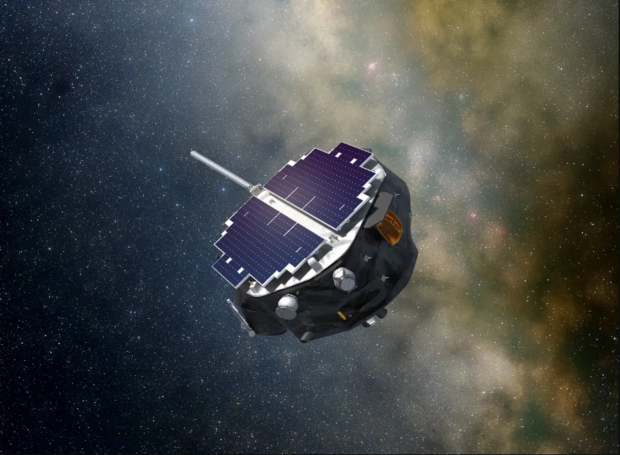
All instruments on board NASA’s Interstellar Mapping and Acceleration Probe (IMAP) spacecraft have successfully recorded their first measurements in space.
Among the instruments, the Magnetometer (MAG) developed by Imperial scientists has begun capturing vital information on magnetic fields stretching across the Solar System.
These “first light” observations mark a major milestone as IMAP begins collecting preliminary science data en route to its destination.
Launched in September 2025 from Cape Canaveral, IMAP is designed to map the boundaries of the heliosphere, a giant bubble created by the solar wind that surrounds our Solar System, and study how it interacts with the local galactic environment.
The mission is currently on its way to its operational post at Lagrange Point 1 (L1), a stable point in space about one million miles away from the Earth towards the Sun, where it will send data back to Earth within minutes.
To achieve this, IMAP carries 10 dedicated instruments, including the Magnetometer, designed to study various cosmic phenomena.
The UK Space Agency has supported the UK development of the IMAP mission with £4.2 million, including funding for the MAG instrument.
MAG’s role and first measurements
Imperial’s MAG measures the interplanetary magnetic field around the spacecraft, which influences how charged particles move through space and shape the heliosphere. Understanding these fields is key to predicting space weather and its impact on satellites, astronauts and technology on Earth.
The instrument’s first-light data has successfully captured the magnetic component of shockwaves created by the solar wind, an important step in validating its performance and beginning its scientific mission.
Helen O’Brien, IMAP Magnetometer Instrument Manager said:
“We test, and test, and test our instruments on the ground before lift-off to be as sure as we can that they will cope with the mission. But launch, entering a vacuum, leaving the Earth's protective atmosphere are all traumatic events and there is no in-flight maintenance crew. So it's hard to breathe easy until we have powered on and taken our first data.
“The instrument has behaved flawlessly - doing exactly what it was designed to do - measuring intricate magnetic fields out in the harsh environment of outer space. I get goosebumps when I see the data.”
Professor Tim Horbury, Science Lead of the IMAP magnetometer at Imperial College London’s Department of Physics, said:
“We turned on our MAG instrument just a few days after launch. It’s always a really stressful moment, but everything went perfectly. The operations team have been fantastic, the spacecraft itself is working really well, and our instrument is just perfect: it started producing wonderful measurements from the moment we turned it on. We haven’t had to change anything at all. We’re seeing wonderful things in the data already from the tiniest little blips to huge coronal mass ejections sweeping over the spacecraft and towards Earth.
“We’re getting our measurements down in real time so we can help with forecasting space weather at Earth. This is an important part of what we do and shows how we can use a scientific instrument to also help wider society build resilience to these effects.”
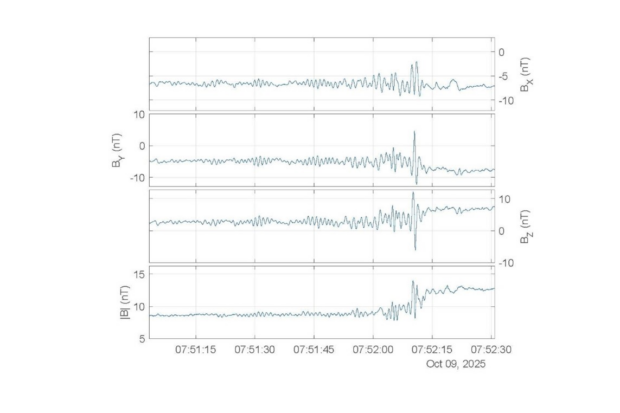
These early observations will help researchers refine models of solar wind behaviour and improve forecasts of space weather events.
Imperial played a leading role in designing and building MAG, drawing on decades of expertise in space magnetometry. The team collaborated with colleagues at Princeton University, led by Professor David McComas as well as Professor Silvia Dalla at the University of Lancashire.
The instrument was integrated into IMAP ahead of its successful launch and is now operating as the spacecraft travels towards L1.
Professor Tim Horbury said:
“The engineering team at Imperial did an outstanding job in getting the instrument built in record time. It was so satisfying to be able to be with them as we watched the rocket lift off the pad and realise the goal that we’d been working towards for five years.”
Why IMAP matters
IMAP will act as a modern-day celestial cartographer, mapping the invisible boundaries of the heliosphere and studying how solar wind interacts with interstellar space.
Its observations will provide critical insights into the processes that accelerate particles to high energies, phenomena that affect space weather and, ultimately, life and technology on Earth.
For example, SWAPI, led by a team at Princeton University and CoDICE, led by Southwest Research Institute (SwRI), measure ions from the solar wind and beyond. Together with MAG, these instruments will help scientists understand how charged particles move through space and how the heliosphere interacts with the interstellar environment.
IMAP is expected to reach L1 in early 2026, where it will begin its full science mission. For Imperial researchers, the successful first-light measurements mark the start of an exciting phase of data analysis that will advance our understanding of heliophysics and space weather.
Imperial’s involvement in IMAP continues its long heritage in space science, following contributions to missions such as Solar Orbiter, JUICE and Cluster.
The success of MAG underscores the university’s leadership in developing instruments that enable groundbreaking discoveries in space physics.
Leave a comment