The peak of the Geminid meteor shower occurs this weekend, and with the Moon out of the way you’ve got a great opportunity to spot shooting stars.
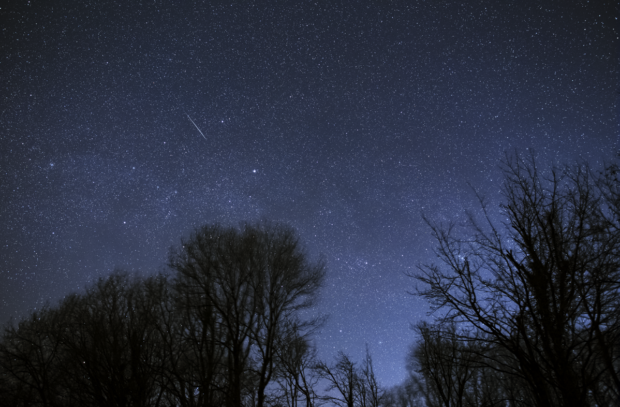
It might not sound like it, but one of the most interesting things about the Solar System is its dust. In fact, the stuff is everywhere in our planetary neighbourhood.
These tiny grains, scattered between the planets, have been deposited by passing comets and asteroids over eons and the signs of it are visible every clear night in the form of shooting stars, or ‘meteors’, which appear as fleeting streaks of light across the starry sky. These meteors occur as the specks of interplanetary dust (typically only the size of a sand grain or fleck of rock salt) hit our atmosphere and vaporise.
At certain times during the year the Earth also passes through denser trails and clumps of this dust left by comets and asteroids and these form so-called meteor ‘showers’ that occur annually. For example, in August we sweep through the dusty trails left by Comet Swift-Tuttle and we see the Perseid meteor shower which is known for its beautiful, bright summertime fireball meteors.
This month is when Earth meets the trail of a somewhat enigmatic asteroid called Phaethon and its dusty debris gives rise to the Geminid meteor shower, which peaks overnight on Saturday (13 December).
The Geminids are arguably one of the best meteor showers of the year, because of the relatively high number of meteors you can expect to see over the course of an hour compared to many of the other smaller meteor showers. However, how many Geminids you’ll actually observe will depend on factors such as your local light pollution levels, how much of your sky is blocked by buildings or treelines, and if there’s any thin cloud or haze obscuring fainter ones. You won’t see a ‘rain’ of myriad meteors as is sometimes claimed, but with a little patience you should catch a handful of really nice ones over the course of half an hour or so, even from suburban sites.
The great thing about 2025’s Geminid shower is that the expected peak of its activity around Saturday night coincides with a time when the Moon sits below the horizon for most of the evening, so its light won’t wash out the sky and hide fainter meteors.
To stand the best chance of seeing the Geminids, find a safe place to observe, wrap up warm and allow your eyes to adapt properly to the darkness around you. You don’t need any equipment to enjoy the show, but a sun lounger or reclining camping chair can make staring up at the sky much more comfortable, even if your neighbours end up thinking you’re slightly odd.
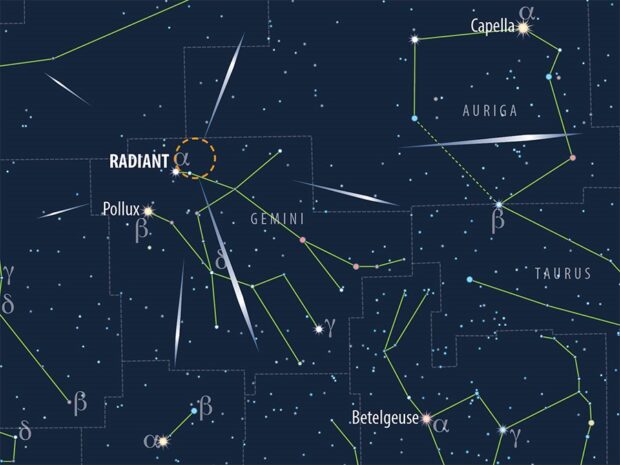
How will you know if you’ve seen a Geminid? Well, because of the physics behind these events all shower meteors appear to come from a specific location on the night sky, called the ‘radiant’ of the shower. For the Geminids this radiant is located in the constellation Gemini (that’s why we call them the ‘Geminids’). So if you see a shooting star streak from a spot close to the bright star Castor (Alpha Geminorum) there’s a good chance it was a Geminid.
While meteor showers like the Geminids provide a fun celestial spectacle to observe, more generally scientists, government organisations and space agencies around the world, like the UK Space Agency, take a keen interest in routine monitoring of large asteroids and comets. This is because some groups of asteroids, on certain orbits around the Sun, can pass close to our planet, potentially posing an impact risk to the Earth.
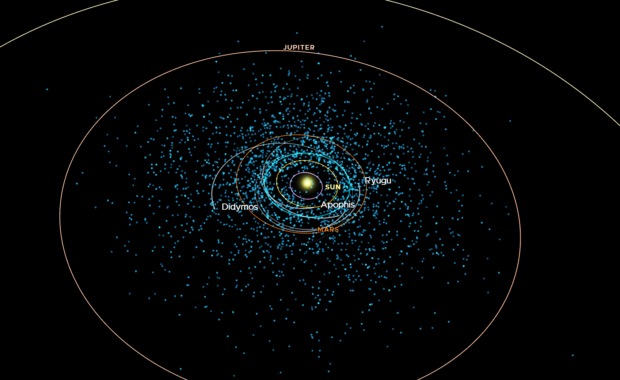
The National Space Operations Centre, a collaboration between the UK Space Agency, UK Space Command and the Met Office, keeps tabs on so-called ‘near-Earth objects’ as part of its work, and if necessary can call on a network of telescopes located across the globe to carry out follow-up observations of targets of interest.
The UK Space Agency is also the UK government’s representative to the International Asteroid Warning Network (IAWN), which notifies officials and national governments if one of these bodies is identified as a potential threat. Something to ponder as you watch the odd, harmless, Geminid zipping amid the stars this weekend…
Leave a comment